Monday, September 19, 2011

Part Three: Dynamic Partnerships and Their Necessity


From my experience in urban communities, most non-profit organizations are hesitant to create partnerships, especially non-profits providing a similar service.   As government funding continues to decrease for human services and communities remain in decline, I grow increasingly confident that partnerships are the key to a thriving non-profit sector.

At the Dynamic Partnerships: The Arts and Community Development workshop, Megan Whilden made great points about why the partnership between the Storefront Artist Projects and Pittsfield’s Office of Cultural Development worked so well, but I was most impacted by her assertion that partnerships should highlight already present community strengths.

Some projects do not highlight present community strengths. For example, the creation of a community mural solely to improve a space’s attraction will not empower the community for real change.  The motivation of any project will be evident to community members by who is involved in the project, the project’s theme, and access to the planning.  When only outsiders are engaged in the project and community members have no part of the planning process, community empowerment will not happen.  Instead, the project will communicate to community members that their community is: ugly, dangerous, insufficient, etc.

The more effective and empowering project involves collectively planning and promoting a design highlighting positive community attributes.  Empowerment will happen when community members are engaged, in their areas of skill, to executive the project.  In order to accomplish this, partnerships with other community organizations in these projects are important: they provide both unity and positive reputation. 

I believe organizational partnerships help community members to see the broader picture in their community.  When organizations begin to function together towards a common goal, it becomes one community.  Competition breeds distrust, and community members can sense this distrust.  If organizations do not trust one another, why should community members trust organizations working on a community project?  In a project, positive reputation helps community members warm to new project and unity helps them feel comfortable enough to participate.

Non-profits resisting partnership are counterproductive and hurting their constituents.  The best projects are those approaching communities from a holistic perspective: just like a person, communities have multifaceted needs.  Community problems are usually much more complex than projects care to address.  The simple route is indeed to say that a community is not thriving because of _______ (a lack of jobs, you fill in the blank), but providing just _________ (allowing a new factory to be built in the community, a one-dimensional service) does not provide the whole answer (community members with the skills they need or remove the obstacles they have to succeed in a newly obtained job, other problems below the surface will exist).   When non-profits come together, they often are able to provide a more holistic project that successfully addresses the “whole” problem.

Partnership promotes unity, positive engagement, and holistic solutions in communities.  When non-profits overcome their fears of partnership and need to compete, the result will be thriving organizations and communities.  

Friday, September 16, 2011

Part 2: Dynamic Partnerships and the Role of Art in Revitalization


While Pittsfield Storefront Artist project was not intentionally designed to promote economic development, the natural outpouring of their efforts was attracting businesses.  It seems as if beautification of the space gave people motivation to return downtown.  This is an example of how artists can become social entrepreneurs: those who create opportunities in their neighborhood while earning a living (SIAP, Cultivating “Natural” Cultural Districts).  

Keynote speaker, Megan Wilden shared that one challenge of partnership with artists/an arts organization is to encourage without destroying the purity of the art.  In other words, when involving art with community development, the focus must always be creating art.  The partnership between the City of Pittsfield and artists seemed to reach an appropriate balance, because artists were cultivated to continue creating art, not attracting businesses.   Around this premise, the partnership provided fertile soil, because in addition to the presence of art, a sense of community was created among artists.  I think this sense of community was an added attraction for residents and businesses. 

University of Pennsylvania’s Social Impact of the Arts Project (SIAP) promotes a model of development integrating neighborhood residents with regional economy and civil society through aiding a transition from creative economy to creative society (Seifert and Stern, Culture and Urban Revitalization).  One way to achieve this is to create opportunities for artists, amateurs, and residents to collide; artists’ centers are an effective opportunity for this collision to occur.  Artists’ centers provide the community open access to the arts, classes, opportunities to mingle with artists and art lovers, mentoring, and useful networks for resource sharing (SIAP, Culture and Urban Revitalization).  Artists' centers make it more about relationships than transactions; thus creative society rather than economy.


Practically, how do artist’s centers revitalize communities?  Artists’ centers are so are embedded in the lives of community members that it provides: youth development through classes and mentoring, increased neighborhood safety through heavier foot traffic in the community, and improves local economy, as more foot traffic leads revenue for local businesses (Seifert and Stern, Culture and Urban Revitalization).  Moreover, stronger community relationships always generates greater community security among residents.


Cultivating the arts through partnerships in local communities is very effective as the arts continue to become more open and accessible to the general population.  The arts are powerful expressions of culture and experience, so it only seems natural that community revitalization engages art to empower community members and tell the neighborhood story.  Increased access has also uncovered the presence of organic art in low-income communities through anything from graffiti, to rap and spoken word, to resident gardens.  As stories are told, these organic artists are empowered to embrace their talent and use it towards personal, community and maybe even professional transformation.  

Resources:
Seifert, Susan, and Mark Stern. "Culture and Urban Revitalization: A Harvest Document." Social Impact of the Arts Project (January 2007). Web. 14 Sept. 2011. <http://www.sp2.upenn.edu/SIAP>.
Seifert, Susan, and Mark Stern. "Cultivating “Natural” Cultural Districts." Creativity and Change (September 2007). Web. 14 Sept. 2011. <http://www.trfund.com/resource/downloads/creativity/NaturalCulturalDistricts.pdf>.

Wednesday, September 14, 2011

Part One: Dynamic Partnerships and Pittsfield, Mass.

Last Thursday, I attended a workshop presented by the Philadelphia Association of Community Development Corporations.  Entitled Dynamic Partnerships: the Arts and Community Development, this workshop began with a Keynote speaker who shared her experience in a partnership between city government and the arts.   Why are partnerships so important? In this three part Dynamic Partnership series, I will talk more about partnerships, and why they are important. To start, I will share the example given by keynote speaker, Megan Whilden.

Megan Whilden is from the community of Pittsfield, Mass.  Pittsfield is the largest city in Berkshire County and in the past, a center of thriving industry.  Like so many East Coast cities, the decline of industrial business brought about general city decline.  General Electric housed a large factory in town that employed about 10,000 residents.  When it closed in 1977, the population decreased by approximately 20,000 people (General Electric / Housatonic River RCRA Site NRD Settlement, Mass.gov).  Decreases in population were accompanied by the closure of many downtown businesses, which left downtown deserted.  However, where residents saw failure, one artist, Maggie Mailer, saw potential.  Maggie decided to initiate a movement that came to be known as the Storefront Artist Project (http://storefrontartist.org).


As their website states, “Following in the footsteps of its nomadic tradition, the Storefront Artist Project continues to find vacant commercial spaces in Pittsfield for artists to use for temporary projects” (http://storefrontartist.org).  For a period of 6 months, artists from around the local area began to occupy empty storefronts and display their artwork.  The agreement between property owners and these artists consisted of: temporary use of the storefront, artists holding their own liability insurance, and artists paying utility costs, while there (Megan Whilden). 


Eventually, due to the success of the Storefront Artist Project, they partnered with the City of Pittsfield’s Office of Cultural Development to promote economic development.  One project they began was 3rd Thursdays, a monthly event that provides evening access to downtown businesses and artists.  As a result of the work by the City and artists, 50 new restaurants and businesses have opened (Megan Whilden).

Resources:

"General Electric / Housatonic River RCRA Site NRD Settlement." Mass.Gov. Energy and Environmental Affairs. Web. 14 Sept. 2011. <http://www.mass.gov/?pageID=eoeeaterminal>.

Tuesday, September 6, 2011

Vacancy and Dilapidation Part 2: What can we do?


Philadelphia is a rich Mecca of community development corporations (CDC) and community organizations, some which have placed a great deal of effort into transforming vacant lots.  One such CDC is New Kensington CDC, which was featured at this year’s annual Flower Show.  "From Blight to Blossom" is the name of the exhibit, and its conception was the result of a partnership between the New Kensington CDC and Philadelphia's Office of Housing and Community Development. Its intention, according to a press release describing the project, is to "tell the story of an urban side-yard transformed from a vacant lot into a garden" (http://www.flyingkitemedia.com/devnews/blossom0308.aspx).   Instead of allowing blight to fester in Philadelphia’s neighborhoods, New Kensington has viewed vacant lots and abandoned homes as areas of potential beauty.  

What can be done with vacant lots?  One potential use of such space is to create new affordable housing sites, the foundation upon which Habitat for Humanity has built their organization.  Other possibilities include using the spaces for parks, community gardens, recreational centers, and even centers of community art.  Some projects such as New Kensington Vacant Land Management Program and Philadelphia Horticultural Society’s Community-Based Vacant Land Maintenance Program have dedicated their efforts towards cleaning and creating parks and community gardens throughout the city.   While the end result is transforming space, the Philadelphia Horticultural Society’s project partners with nine community organizations, including Ready, Willing & Able and SELF, Inc. to employ individuals making the transition back to work after experiencing drug addiction and homelessness.  The Mural Arts Restorative Justice program has also helped with these efforts by employing ex-offenders in cleaning and transforming vacant lots.  The great aspect of these projects is people are given the opportunity to transform themselves through the process of transforming the land.

The Village for the Arts and Humanities is another organization that has transformed a great deal of space in North Philadelphia.  On their campus alone, they’ve transformed over 150 vacant lots into gardens, green spaces housing collections of community art and a two acre farm.  In this particular community, the Village for the arts and Humanities has worked organically by recruiting the help of community residents.  As the Wallace Foundation states: “With a phantasmagoria of mosaic sculptures, murals and gardens glimmering with giant angels and creatures no zoo has ever seen, the Village offers vibrant testimony to the role that art can play in bringing a desolate urban landscape back to life and engaging youth and families in the arts.”  As a result, neighbors are given the opportunity to connect and build relationships, while working together towards a common goal.  In addition, the two acre farm has given the community access to fresh and healthy food options.  

 The Southwest Community Development Corporation also provides a community beautification project that includes a community garden.  One of the 2011 graduates from the MA in Urban Studies, Regina Broomell-Young, assisted the Southwest Community Garden by facilitating research investigating is it was needed in the community: Her researched concluded that the garden was absolutely needed in the community for both health and community organizing purposes.  


While the potential for transformation is available to each of Philadelphia’s 40,000 vacant and abandoned properties, it is a large endeavor from start to finish.  Before starting, there is often the task of acquiring land or permission from owners, which makes the process a laborious one, especially in the cases of those lots privately owned.  For those ready and able for the task, the Philadelphia Horticultural Society has developed a guide entitled Reclaiming Vacant Lots: A Philadelphia Green guide. This guide not own provides practical tips on gardening and landscaping but also highlights steps for the project from beginning to finish.
Steps include:
  1. Resolving Ownership Issues
  2. Mapping Community Resources
  3. Assessing Site Conditions
  4. Developing a Site Plan
  5. Outlining a Maintenance Strategy
  6. Cleaning the Site
  7. Implementing Site Improvements
  8. Performing Ongoing Maintenance
From start to finish, there is much to be accomplished in terms of physical space, but let’s expand our view and see the potential in also lives of community members.  While funding has been cut back for many of the above mentioned projects, hopefully they will be able to endure and continue to impact this generation as well as many to come.   

Tuesday, August 30, 2011

Vacancy and Dilapidation: Part 1


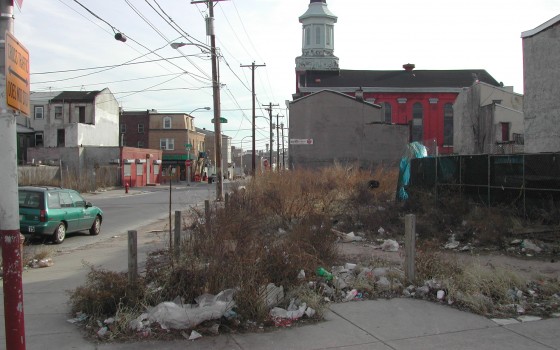
Throughout the city of Philadelphia, as with many east coast cities, there is a large problem with vacant lots and dilapidated buildings.   One of my first times in Philadelphia was to do a walk through of a neighborhood just east of Center City called Point Breeze.   When you are walking the streets of Point Breeze, you can literally look down any road to the West and see a distinct line dividing the glamor of Center City’s high rises and condominiums from Point Breeze’s old row homes mingled with corner stores and vacant lots.   

The distinct lines of urban neighborhoods have always fascinated me, because there are two worlds bordering each other but few will pass between the two.  

A 2010 article in Philadelphia Weekly reports that there were about 40,000 vacant lots spread throughout the city (Kase, 2010).  There are many problems associated with vacant and abandon properties including declining property values in surrounding communities, loss of money to the city in unpaid taxes, neighborhood safety, illegal dumping, and overall neighborhood blight. 

What has caused all of these vacancies?  Some contributors have been the change from an industrial to more technologically driven society.   Once more mechanic methods of industry and practices such as outsourcing took over, bustling centers of business became haunts, reminding many of “what used to be.” Also, rising costs of home ownership, declining property values, and rising foreclosure rates have contributed to this problem.  As more people are unable to keep up with the rising costs of energy, taxes, insurance and repair, they are either forced out or abandon ship.  Of the 40,000, about 12,000 properties are reported as being public owned, mostly as the result of foreclosure, I’d assume (Kase, 2010).  Combine all these industrial and economic changes, and you are left with a literal mess in cities like Philadelphia.

Shot of vacant lot in Lucas' article
One woman reported to a Philly.com reporter that she has been living next to a condemned building for four years; the property has an overgrown back yard with a hole into the vacant home, which draws in drug users, children playing, and vermin like rats and roaches (Lucas, 2011).  Needless to say this is both a public health and safety hazard for community members, especially children.  Unfortunately, lots such as these contribute to a lack of city pride across Philadelphia, and Lucas’ article goes on to quote a resident that says neighbors and city agencies, “Just don’t care” (Lucas, 2011).   The interesting question is, “Do they not care, or have they given up hope?”   It is easy to understand why they feel hopeless, when they look around at land forgotten and abused. 


Sources: 
 Lucas, Phillip. "Marquis of Debris: They're Sick of These Dumps." Featured Articles from Philly.com. Philly.com, 18 Aug. 2011. Web. 30 Aug. 2011. <http://articles.philly.com/2011-08-18/news/29900900_1_trash-pit-neighbors-drug-addicts>.

Kase, Aaron. "The Ugly Truth About Philly's Vacant Lots | News and Opinion | Philadelphia Weekly." Philadelphia Weekly | Local News, Reviews, Multimedia, Music, Real Estate and More. Philadelphia Weekly, 16 Nov. 2010. Web. 30 Aug. 2011. <http://www.philadelphiaweekly.com/news-and-opinion/The-Ugly-Truth-About-Phillys-Vacant-Lots.html>.

Thursday, August 25, 2011

A Lack of Foresight

While in my undergraduate program, I often studied issues related to urban poverty.  After three years of avid study, I felt my research always pointed to this as a top cause of poverty: single parenting and specifically teenage parenting.  While teenage pregnancy is an issues found in more than urban areas, statistics indicate that urban areas as the epicenter of this problem.  Take Pennsylvania, for example.  The city of Philadelphia has historically and still tops the state in pregnancy rates.   The rate is calculated by the amount of pregnancies over the number of females ages 15-19 times 1,000, so the rate does not mean the rate is high just because there are more teens in Philadelphia than other places in the state.

When I graduated, it was my desire to serve the single parent population, so I began working full-time at an organization that provided services including teen parenting workshops and special programs.  I had the opportunity to meet with several teen moms, during my time working for this organization.  I found that teen moms are taxed with a very heavy burden, often with little support.  For some, parents will kick them out of the house, leaving mom and baby homeless.  Also, there are a number of teen moms not support financially or emotionally by their “baby daddy,” but I will add that I seemed to see a lot of young men really trying to step up and be supportive.  For teen moms, dropping out of school is often the only option, because they must work to support their child or children.  All of this wraps up into a cyclic problem, as undereducated teen moms will continue to struggle financially in the future, because they lack the education to get stable and well-paying jobs.  I’m not even going to get into the problems for children of teen parents. 

All in all, teen parents are in dire need of quality services providing the support they need to thrive.  I had heard of the ELECT (Education Leading to Employment and Career Training) program when I worked in my first job, but I did not hear about the impact of their organization until I read a July article in the Inquirer.  ELECT is a statewide program, but given the concentration of teen pregnancy in Philadelphia, it has always been the focus.  Starting as primarily a service to provide teen parents with education and career support, it has evolved to provide medical, child care, transportation, and counseling referrals. 

According to the Inquirer Article titled Program for Pregnant Students has Unclear Future, “ELECT serves about 1,000 students, a dam against the joblessness and despair that routinely await unwed teenage dropouts… Nationally, only 40 percent of mothers who have children before age 18 go on to graduate. Many drop out in Philadelphia, too, though ELECT cites a high graduation rate. Last school year, among 403 students who met the criteria for graduation - completing course work and other requirements - 369 graduated. That's 91 percent.”  Despite the success of this program, it seems that the state budget has determined this program less worthy than other items, and the summer program and middle school aged afterschool programs have been cut. The state of the main in-school program will depend upon the allocation of funds from the Department of Education and Public Welfare Offices.

Considering the massive cuts in school budgets, I do not think the Department of Education will have a lot to spare, and looking at a breakdown of the 2011-2012 budget there are many cuts to Public Welfare spending.  In researching for follow-up information on the state of ELECT, I have not been able to locate any information, but I am afraid that this will be another casualty of economic war.  The shame really is, “The cost of teenage births to state taxpayers, in lost tax revenue, public health care, and children welfare runs $463 million a year” (Gammage, 2011).  A lack of foresight seems to be the biggest problem that our state government is unable to overcome. 

Source: Gammage, Jeff. "Program for Pregnant Students Has Unclear Future." Philly.Com. The Inquirer Digital, 19 July 2011. Web. 19 July 2011. <http://www.philly.com/philly/education/20110719_Program_for_pregnant_students_has_unclear_future_1.html>.

Friday, August 19, 2011

Peaceful Resistance and Community Organizing


Anna Hazare is a name that has been hyped through world news broadcasts for the last couple of months.  Said to be working from a Gandhian influence, Hazare has been using similar protest tactics (such as peaceful resistance) to ensure government action against corruption.  In terms of government action, Hazare’s movement to demand the institution of anti-corruption laws and now the creation of an anti-corruption agency.  He has even instituted fasts-to-the-death.  


When reading articles about Hazare, I was forced to question his comparison to Gandhi.  Were they using peaceful resistance in the same way?   I did not feel at peace about comparison of Hazare to Gandhi, especially his use of fasts-to-the-death.  Hazare’s first was instituted with a condition that he would not eat until the government passed an anti-corruption bill.  Primarily, Gandhi campaigned for India’s independence because of the injustices being committed against its citizens.  He fought against injustices such as “untouchability,” alcoholism, ignorance and poverty.  His fasts were motivated to fight these injustices and bring unity, never to demand independence from the government (http://www.telegraphindia.com/1110621/jsp/opinion/story_14136304.jsp).  Hazare’s specific demands upon the government through fasting does not reflect Gandhi in that it lends to violence, and some have argued is violent in and of itself.  

When I read about Hazare’s fast-to-the-death, I was first struck with the potential this had to initiate violent retaliation.  The public has indeed been energized by Hazare to stand up against government corruption, and he is now a national symbol.  The fact that he is such a valued symbol to the people of India, makes me questions his tactics.  What if he dies because the government does not meet his demands?  I imagine it would cause chaos. Unlike Gandhi, Hazare has a very tangible opponent on which the people can reflect their anger, which amplifies the potential for violence.    

All in all, my point is that protest and peaceful resistance must be used carefully, as it can easily be distorted into riot.  Consider the London Riots over an unprovoked police shooting.  While citizens were impassioned for the right reasons, (the injustice of this incident) the result was destructive rioting.  It seems the human psyche can easily cross the line to violence, when passion is evoked, so even if the intent is peaceful, the result can be violent. 


How does this relate to the urban context?  I have begun to think about peaceful resistance in the context of urban communities and its effectiveness in community organizing.   Can peaceful resistance be used to bring awareness to injustices in our current climate?  It was very effective in the 1960s with the Civil Rights movement, and a whole generation of African Americans were empowered to speak out against injustice and helped to change significant legislation.  Could this work today?  


As mentioned above, I think that it can be a very powerful tool, but it has to be used delicately.  In the wake of flash mobs, not only in Philadelphia but in cities like Chicago and Germantown (MD), teens have been motivated to demonstrate their frustrations.  While I am not sure the exact nature of their frustrations, I can imagine they might about: the educational system, police brutality, gun violence in their communities, parents having to work multiple jobs, blatant acts of racism, etc.   In the absence of guidance, these youth started a movement to action that quickly turned violent, but if mobilized by someone with a vision, things could be different.  

I believe that figures like Gandhi or groups of people like community development organizations can be necessary in guiding in peaceful resistance, but things can become dangerous when the focus is too concentrated upon the figure or group.  There has to be a point where that figure or group can step away.  This point must be when the community members are empowered to organize themselves.  Along with empowerment, there must be a sense of unity binding the community together.  Like Gandhi, I believe the point of resistance is point out a structural injustice and unify people towards finding a solution.     


I can picture protest and peaceful resistance being effective is many urban injustices.  Thinking back to the spring, students in the Philadelphia school district I think formulated a very successful act of peaceful resistance with walk-outs at Audenried and West Philadelphia High Schools (http://articles.philly.com/2011-02-16/news/28538690_1_33d-and-tasker-streets-audenried-high-school-students-renaissance-schools-initiative/2).  Student leaders mobilized students to come together at the School District building to show their resistance to the schools becoming Promise Academies.  While officials and some parents were upset by it, I think that it was great example of peaceful resistance and students dealing with their frustrations in the productive way. 

  • What do you think about peaceful resistance?   
  • Do you have examples of it being used in the urban context?